Basic Cable Cataclysm 5/15/20

cataclysm

Basic Cable Cataclysm

5/15/2020

This is what I know. At this moment Los Angeles is closed until August. Prisoners are sewing cloth masks in shifts. My college expects a four-hundred million dollars deficit, but it may be more. It has rained for five days straight, and will rain for the next five. My brain chemistry was off one day this week. The highway bisects a Christmas-Day landscape of empty parking lots and locked storefronts. Armed protestors have blocked ambulances. Animal shelters are running out of puppies. Hairdressers will return at warp speed. I know all this from the network news. But nobody knows anything. 

We can only wait to see which institutions, long held-over from the Industrial Revolution, sink through the cracks in their foundations and which settle. In the meantime I type prose or sketch. This is a season of substitutes and stand-ins when even books cast discouraging shadows. In Heaven and Hell Huxley writes about, “…the vast impersonal universe.” In Letters to a Young Poet Rilke warns, “We are unutterably alone, essentially, especially in the things most intimate and important to us.” Yes and. Yes and. Yes and.

The forest floor is never as fertile as after the fire. World War I ended Modernism, and made way for Lost Generation writers and Surrealism. Art is conceived in crisis. It is nurtured in the bodies of the dispossessed. It is only newborn after cataclysm. One reason I continue to chase lines that strike true is to take up the time between Before and After. Another is to avoid becoming the charcoal left behind.

Gil Scott-Heron recorded “The Revolution Will Not Be Televised” in 1970. Fifty years later ours is broadcast without pause, but no one watches basic cable. Until the seismic fracturing of The Before steadies to tremors I am keeping my idle hands busy. The waves of The After will touch the shore. I want to wade into them with a quiet mind. The only thing anyone knows for certain goes without saying; What we leave behind never returns the same.

Watch this

Aldous Huxley interview from 1958 which remains contemporary.

Read this

Letters to a Young Poet: Letter 4,” Ranier Maria Rilke
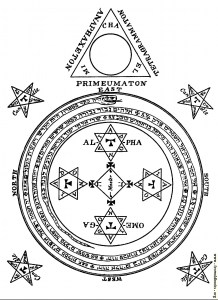
Magic Circles: Big and Small 5/5/2020

124-The-magical-Circle-q85-1658x2283

“Time is a flat circle.”- True Detective

“All this has happened before. And all this will happen again.”- Peter Pan  

In this time of necessary separation I have spent the last week considering separation as concept. I spend most of my days locked away for the majority of my waking hours. I have always had the necessity for manifest absence both for psychological and creative space, as well as for a sense of security. My life has returned to the same pattern it followed when I was a ten-year-old. I segregate myself to read or try to make things. Otherwise I track through the woods alone.

The Dutch historian Johan Huizinga explored separation in a diversity of 16th century Faust tales. One of his points of interest in these stories was their use of “ the magic circle” as both a symbol (representation) and presence (manifestation). He saw the magic circle, whether drawn on the floor or in the form of a pentacle over a doorway, in these stories as a boundary that separated one world from the other; a temporary world within the ordinary dedicated to a given act wherein one is in the hands of the supernatural. His defined the magic circle as a created a place for accomplishing within them what could not be achieved without. 

Everyone creates, intentionally or not, their own magic circles to step outside the responsibilities and routines of living. They are fashioned out a record player and a cocktail. They are invisibly drawn around a park bench with an open notebook. Artists are especially guilty of this innate mysticism. Late at night in my basement office I am conscious that I am in a place where physical boundaries stand and the barriers to inspiration thin if not fall.

Magic circles as practiced separation exist in small ways too. Victor Frankl in Man’s Search for Meaning defined the necessity for the minute magic circle that we psychically etch between stimulus and reaction. To him suffering was meaningless; only our reaction had any value. Scott Carney in his new book The Wedge explores a similar human ability to form a gap between external stressors (from ice baths to oxygen deprivation) and the physical responses they trigger. Each of us has developed our own small magic circles to navigate being. These spaces (call them meditation, cognitive dissonance, grit, sisu, etc.) don’t only belong to daredevils, monks, and occult philosophers. They are the letters we write, and never send. They appear in the patience we practice when faced with our failings.

I am indulging exiting one world for the other during this season of separation. Even if my practices and preferences lean toward the monastic, still I don’t want to let this expanding divide go to waste. Summer is only a few weeks away. Who knows how long it will be before the real world circles back again?

  What to read

 “W.B. Yeats, Magus” by Jamie James Lapham’s Quarterly
 “The Mysterious Mr. Parsons-Life at the Crossroads of Crowley and Hubbard” Mike Luoma Medium

Love Song for a Quarantine 4/28/20

6044_M_JW_Didion_1720_frame_22.0

Two months. Maybe less. And now I am institutionalized, in love with the quarantine. In my office hideout time mirrors a casino. I know whether it is day or night, but which on the calendar is mostly uncertain. This is more than a small freedom.

 There is an envelope in my office full of heads. Carson McCullers. Yeats. Warhol. I decapitated each from postcards in college. There are bodies too. Brando sulking in an undershirt. Kerouac, back to brick wall, staring over all that rolling nothing. I study these along with Polaroids taken in dorm rooms. I re-watch black and white interviews with authors who accentuate their points with cigarettes. They seem so serious, so worldly and old though they were so young. I sift through these fragments from when my ambition to write was fresh and all-consuming.

In a life separate from clock and calendar I have gotten more pages down than in years. The new novel is going well, if slower than usual due to the attention I pour over each sentence. It would be quicker to translate what I want to say from Latin, but I want this book to be lean and beautiful. Short stories and poems come in flashes once in a while too. Days, weeks, and months cut off from all except the most tangential relationship with work are a gift. I live in the Twilight Zone episode “Time Enough at Last” with no need for glasses

Words have begun to stick in my head lately like half-remembered lyrics though. Today the word is “svaha.” In Yogic philosophy it essentially means, “let go.” It’s the same as the Buddhist principle of “non-attachment.” And on one level it is silly to make distinctions between Yogic, Hindu, or Buddhist philosophy. Or any school of philosophy since each wrestles with the same question: “What do we accept as truth out of tradition, and what is ultimately true?”

Be safe. Below are some timely works for you this week.

Listen to these

Radio Lab “In the Dust of This Planet” (pessimistic philosophy in pop culture, Dadaism, history)

Franz Liszt “Love Dream” (one of my favorite short classical pieces)

 Read these

Thomas Pynchon “The Deadly Sins/Sloth; Nearer, My Couch, To Thee” (New York Times)

Anne Didion “Slouching Toward Bethlehem” (Saturday Evening Post)

 Watch this

The Center Will Not Hold (Netflix)

Reading at Brescia University

BreschiaReading

On September 6th I will be reading and signing at Brescia University with poet Daniel Abbott. I’d love to see you there.

The 2017-2018 edition of the St. Ann St. Visiting Writers Series at Brescia University kicks off with a visit from Michael Wayne Hampton of Cincinnati, Ohio and Daniel Abbott of Grand Rapids, Michigan.

Hampton is celebrating the release of his debut poetry collection “The Tax For Loving” (Eliezer Tristan Publishing, 2018.) He is also the author of the novella “Roller Girls Love Bobby Knight,” the story collection “Romance for Delinquents,” and a fiction chapbook, “Bad Kids From Good Schools.” He teaches creative writing at the University of Cincinnati-Clermont.

Abbott’s debut novel “The Concrete,” was release this year by IG Publishing. He holds a Master of Fine Arts in Creative Writing from the Vermont College of Fine Arts.


My Year in Writing 2017

larger

My Year in Writing 2017

This year I’ve focused most of my attention and energy on becoming a better, stronger, and more peacefully-minded person, which has been incredibly beneficial for me, but has also led to my writing suffering more than it should. Next year my focus will be on creation, but in the interest of reflection this is what I have to show for my year in writing.

Fiction:

Most of this year my fiction writing was spent working on the final version of my new novel that is in its home stretch. I can’t wait to send it to my agent so that I can tackle the other books I have outlined, and finish the half-dozen or so stories I have started. With that being said I was fortunate to have three reprints of earlier stories come out this year as well as a new flash fiction piece.

“The Baddest Man in Three Counties,” and “Slow Day at the S.A.” reprinted in Flush Fiction

“Slow Day at the S.A.” additionally reprinted in Paper and Ink Zine

“Target Model” flash fiction printed in Culture Cult Magazine

Poetry:

I sent out poetry for the first time this year, after writing it for the first time in decades. While I still have a few poems out for consideration, I haven’t written poems in earnest for the last six months or more, but am thankful to have had eleven of my poems find a home.

“Teenage Pin-up” poem Zoomoozophone Review

“Capsule” poem Foliate Oak Literary Magazine

“Vellum” poem (b)oink Zine

“Bruises,” and “Your First” poems Voices

“In a House of Dying Men” poem published in Waypoints

“Drive” poem published in Vagabond City

“Séance” poem published in Succor

“How I Write Poetry” poem published in Helen

“Failure,” and “Diary” poems published in Rust and Moth

Essay:

I wrote an essay reflecting on my fight with major depression, and the feelings of loneliness and abandonment that come with it, and was thrilled to have it published since it’s a hybrid work that’s both scholarly and deeply personal.

“Escaping Loneliness” published in The Manifest Station

Interviews:

I was lucky enough to be interview by author and educator Ben Tanzer for his podcast This Podcast Will Save Your Life

Other random coolness:

In March I got a shout out from Daniel Handler (a.k.a. Lemony Snicket) for my novella Roller Girls Love Bobby Knight

I started a Tiny Letter to share with all of you, and have truly enjoyed reading your own work and thoughts.